


Table of Contents
- How to Choose Oversized Fit: Size Up or Stay True?
- The Difference Between Relaxed and Oversized Fit
- How Fabric Weight (GSM) Changes the Drape
- Oversized T-Shirt Size Guide: Where the Seams Should Sit
- Shrinkage Management: Protect Your Fit in the Wash
- How to Style Oversized Tees for Your Body Frame
- Conclusion: The BLNCE Standard for Oversized Fit
- Frequently Asked Questions
Last Updated: September 8, 2026
How to Choose Oversized Fit: Size Up or Stay True?
The oversized fit is the defining silhouette of modern streetwear, yet most people get it wrong by asking the wrong question. When you learn how to choose oversized fit correctly, you stop guessing between a medium and a large and start reading the garment itself. At BLNCE Streetwear, we build every piece from 300GSM+ heavyweight cotton, which means we have a strong opinion on this: the difference between a tee that looks intentional and one that looks like a mistake comes down to measurements, fabric weight, and seam placement, not the number on the tag.
Why 'Size Up' Is the Wrong Question
The most common advice across fashion forums is to simply buy a size or two up from your regular fit. That guidance fails because tag sizes are inconsistent across brands, and sizing up a structured tee produces a completely different result than sizing up a relaxed one.
A true oversized fit is not a larger version of a regular tee. It is a distinct cut with a wider chest, a dropped shoulder, and a boxy, straight silhouette that falls away from the body. When you size up a regular-fit garment, you often get excess fabric in the wrong places: sleeves that bunch at the wrist and a torso that drapes like a curtain rather than holding a clean line.
Garment Measurements Beat Tag Sizes
The reliable method is to ignore the tag and compare garment measurements against your own body. A fit guide built on chest width, shoulder seam, and total length will always outperform guesswork.
Here is the practical process to follow:
- Measure your chest circumference at its widest point.
- Measure a tee you already own that fits the way you like, laying it flat from pit to pit.
- Compare that flat chest measurement to the size chart of the garment you want.
- Check the shoulder seam width and the total length against your frame.
For a proper oversized fit, look for a chest width roughly 10 to 15 centimetres wider than your actual chest measurement (fashiondex.com). This extra room creates the relaxed silhouette without swimming in fabric.
The Difference Between Relaxed and Oversized Fit
Understanding the difference between relaxed and oversized fit is essential because the two terms are often used interchangeably, yet they produce very different looks. A relaxed fit adds a small amount of ease through the body while keeping the traditional shoulder seam in its natural position, whereas an oversized fit fundamentally restructures the garment's proportions.
Fit Profile: Relaxed vs. Boxy vs. Dropped Shoulder
Three distinct fit profiles dominate modern streetwear, and each suits a different aesthetic:
| Fit Profile | Shoulder Seam | Silhouette | Best For |
|---|---|---|---|
| Relaxed | Natural position | Slight ease through body | Clean, understated layering |
| Boxy | Extended 2-4 cm | Straight, square cut | Structured, intentional look |
| Dropped Shoulder | Extended 5+ cm | Wide, loose drape | Maximum streetwear aesthetic |
The dropped shoulder is the hallmark of an intentional oversized tee. The seam sits well past your natural shoulder bone, creating that slouched, relaxed line that defines the streetwear aesthetic. A boxy fit keeps the structure but widens the frame, which suits broader body frames better.

How Fabric Weight (GSM) Changes the Drape
Fabric weight is the variable most guides ignore, and it is the one that determines whether an oversized tee looks premium or sloppy. GSM, or grams per square metre, measures fabric density, and it directly controls how the garment drapes on your body. But weight is only half the equation. The fibre composition, what the yarn is actually spun from, dictates whether that weight feels stiff, fluid, or somewhere in between.

The GSM Baseline: Structure vs. Collapse
Lightweight cotton around 150 to 180 GSM drapes softly and clings to your frame, which defeats the purpose of an oversized cut (textileschool.com). Heavyweight cotton at 300GSM and above holds its structure, creating that crisp, boxy shape that stands away from the body rather than collapsing against it. The difference is immediately visible: a heavyweight tee maintains its silhouette through a full day of wear, while a lighter fabric wrinkles, stretches, and loses its shape by midday.
This is why our BLNCE collection is built around 300GSM+ cotton. The heavy fabric is what allows the oversized proportions to read as a deliberate design choice rather than a sizing accident.
The Missing Variable: Fibre Composition and the 'Hand Feel'
Two tees can share the same GSM and drape entirely differently. The reason is the fibre blend. Here is how the common compositions behave in an oversized cut:
- 100% Cotton (Combed or Ringspun): The gold standard for structure. The fibres are twisted tightly, creating a fabric that is dense, breathable, and holds a sharp crease. It will feel substantial in the hand and will stand away from the chest. The trade-off is that pure cotton is more prone to shrinkage and can feel stiff before the first wash.
- Cotton-Polyester Blend (e.g., 50/50 or 60/40): Polyester adds durability and resists wrinkling, but it also introduces a synthetic 'slipperiness'. A 300GSM cotton-poly blend will feel heavier than it looks but will drape with a softer, less structured fall. It clings slightly more to the body because the polyester fibres do not have the same natural 'spring' as cotton. This is a good choice if you want an oversized look that is more fluid than boxy.
- Cotton with Elastane/Spandex (e.g., 95/5): This is a warning flag for an oversized fit. The stretch allows the fabric to conform to your body, which directly contradicts the straight, boxy silhouette you are trying to achieve. A stretchy oversized tee will bag at the elbows and bunch at the waist rather than falling cleanly.
The 'Pinch and Release' Test
Why the 'Drape' Matters More Than the Weight
In the context of an oversized fit, you are not looking for weight for warmth; you are looking for weight for drape. A 300GSM fabric that is 100% cotton will create a 'statue' effect, a clean, vertical line from the shoulder to the hem. A 300GSM fabric with a high polyester content will create a 'curtain' effect, it will fold and bend more easily, which can look sloppy if the cut is too wide.
When you are choosing between two oversized tees of similar weight, always prioritise the one with the higher cotton content if you want the classic streetwear structure. If you prefer a more relaxed, almost vintage-washed drape, a blend will get you there faster, but you will need to be more careful with the fit to avoid looking like you are swimming in fabric.
Oversized T-Shirt Size Guide: Where the Seams Should Sit
Getting the seams right is the difference between an intentional oversized look and a sloppy one. The shoulder seam, sleeve length, and hemline each have a specific target position that signals a considered fit.
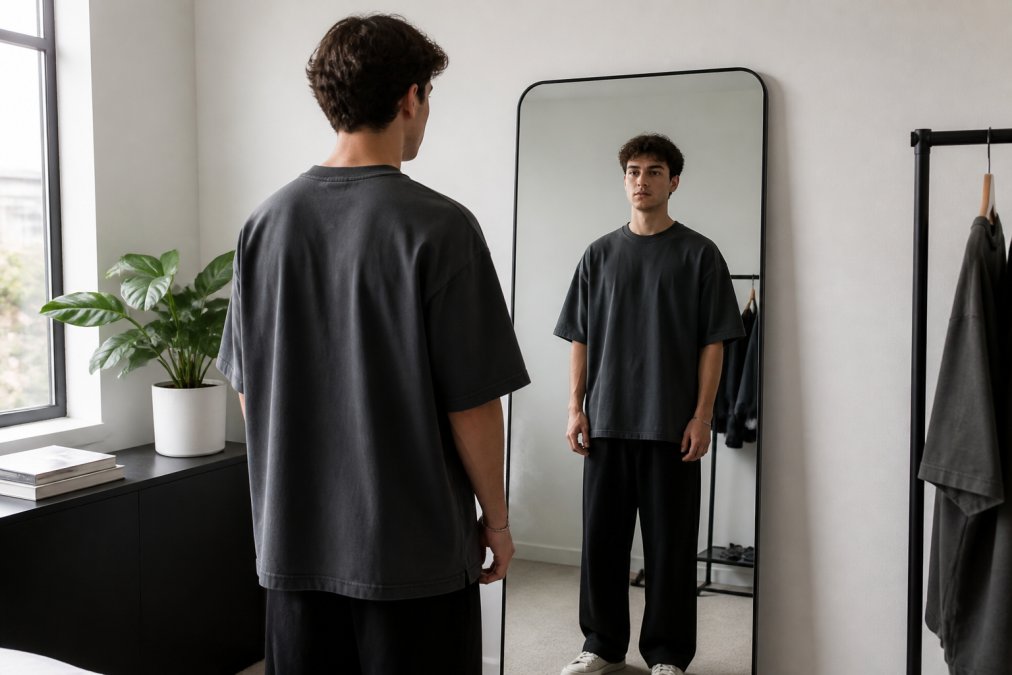
Shoulder Seam and Sleeve Length
The dropped shoulder seam should end partway down your upper arm, typically 3 to 6 centimetres past your natural shoulder bone. If the seam sits exactly on your shoulder, the tee is not oversized, it is simply a regular fit in a bigger size.
Sleeve length on an oversized tee should reach the middle of your upper arm, stopping well above the elbow. Sleeves that extend past the elbow create a sloppy, unintentional look, while sleeves that stop too high break the relaxed line of the silhouette.

Hemline and Torso Length
The hemline is where most oversized fits go wrong. A well-proportioned oversized tee should end between your hip bone and mid-crotch, depending on your height and the look you are after.
For most body frames, the hem should sit no lower than the bottom of your fly. Anything longer reads as a dress rather than a tee, and it throws off your leg proportions entirely. The boxy fit works because the straight hemline creates a clean horizontal line that balances the width of the shoulders.
Shrinkage Management: Protect Your Fit in the Wash
Shrinkage is the silent killer of an oversized fit, and it is the reason many people abandon the style after one or two washes. A tee that fits perfectly on day one can shrink into an awkward, mid-weight mess after a hot wash and a tumble dry.
The rules for protecting your fit are straightforward:
- Wash in cold water, never hot, to prevent the cotton fibres from contracting (cottoninc.com).
- Line dry whenever possible, as machine drying is the primary cause of significant shrinkage.
- If you must use a dryer, use the lowest heat setting and remove the garment while still slightly damp.
- Wash inside out to protect the fabric surface from friction and pilling.
Heavyweight cotton at 300GSM is more resistant to shrinkage than lighter fabrics because the denser weave holds its structure better. However, no cotton garment is immune to poor care. A quality heavyweight tee that is washed correctly will maintain its fit and structure for years, which is the entire point of investing in premium fabric over fast fashion.
How to Style Oversized Tees for Your Body Frame
Styling an oversized tee well depends on matching the proportions to your body frame. The same tee that looks sharp on one person can overwhelm another, and the difference comes down to balance. Most generic advice stops at 'wear it with slim jeans', but that fails to account for the two most common problem frames: the tall/slim build and the short/stocky build. Here is how to tailor the oversized silhouette to your specific proportions.
The Tall and Slim Frame: Add Width, Not Length
If you are tall and slim, your challenge is that an oversized tee can make you look even longer and thinner, turning the 'relaxed' aesthetic into a 'lanky' one. The goal is to add visual width to your frame, not vertical length.
- Choose a Boxy Cut Over a Dropped Shoulder: A boxy fit with a 2-4 cm extended shoulder seam adds mass to your upper body. An extreme dropped shoulder (5cm+) will elongate your arms and torso further, making you look narrower. Look for a tee with a wider chest measurement relative to your own to create the illusion of a broader torso.
- Watch the Hem Length: For your height, a hem that sits at your hip bone is ideal. Avoid tees that fall to mid-crotch, as they will cut your long legs and make your torso look disproportionately long. You want the hem to create a horizontal line that visually 'stops' the length.
- Pair with Straight-Leg or Slightly Tapered Trousers: Avoid slim-skinny jeans. They will exaggerate the vertical line. A straight-leg or a 'relaxed tapered' trouser (wide at the thigh, tapering slightly at the ankle) will ground the outfit and add mass to your lower half, balancing the boxy top.
The Short and Stocky Frame: Create Vertical Lines, Avoid the Tent
If you are shorter and have a broader chest or shoulders, the risk is that an oversized tee makes you look like you are wearing a tent, shortening your legs and adding visual bulk. The goal is to create a clean vertical line that elongates your silhouette.
- Avoid the Dropped Shoulder: A seam that falls 5cm+ past your shoulder will make your arms look shorter and your upper body look wider. Stick to a 'relaxed' or a subtle 'boxy' cut where the shoulder seam extends no more than 2-3cm past your natural shoulder bone. This gives you the room through the chest without the slouch.
- Prioritise a Cropped or Hip-Length Hem: This is non-negotiable. A hem that falls below the top of your fly will visually shorten your legs. Look for an oversized tee that has a slightly cropped hem (ending at the hip bone) or one that you can confidently tuck in. A clean tuck creates a defined waistline and elongates the leg.
- Fabric Weight is Your Friend: Choose a 300GSM+ heavyweight fabric. The structure will hold its shape away from your body, preventing the fabric from clinging to your chest and stomach, which can add visual bulk. A flimsy, lightweight fabric will drape over every curve and make you look larger than you are.
- Pair with a Fitted Bottom: Contrast is critical. Wear the oversized top with slim-straight or tapered chinos or denim. This creates a 'V' shape, broad at the top, narrow at the bottom, which is the most flattering silhouette for a stocky frame.
The Universal Rule: Proportion Contrast
The 'Mirror Test' for Your Frame
Stand in front of a full-length mirror and take a photo. Look at the negative space between your arm and the side of the tee. If the gap is a straight, clean line from your armpit to the hem, the fit is working. If the fabric balloons outwards at the waist or bunches up under your arms, the cut is wrong for your frame, regardless of what the size chart says.
Conclusion: The BLNCE Standard for Oversized Fit
Choosing the right oversized fit comes down to understanding garment measurements, fabric weight, and seam placement rather than blindly sizing up. A 300GSM+ heavyweight cotton tee with a dropped shoulder and a boxy silhouette will always outperform a lightweight regular-fit tee purchased two sizes too large.
This is the standard we hold at BLNCE Streetwear. Every oversized tee in our collection is cut from heavyweight cotton, made in Australia, and designed to hold its structured shape through repeated wear and washing. When you invest in a piece built this way, you stop replacing your wardrobe each season and start building one that lasts.
Frequently Asked Questions
Should I size up or size down for an oversized fit?
Do not simply size up from your regular tee size. True oversized garments, like the BLNCE Legacy Oversized Tee, are cut with a wider chest and dropped shoulder in their intended size. Sizing up on a regular tee creates excess fabric in the wrong places, like the collar and armpits. Instead, compare the garment measurements on the size chart to your own, and choose the size that gives you the intended boxy fit and shoulder drop.
How should the shoulder seam sit on an oversized t-shirt?
On an oversized fit, the shoulder seam should sit past your natural shoulder bone, down your upper arm. This is called a dropped shoulder. A good rule is that the seam should end a few centimetres down your arm, creating a relaxed silhouette. If the seam sits right on your shoulder, the tee is a regular fit. If it sits more than a third of the way down your upper arm, the fit may be too large.
How can I tell if an oversized shirt fits correctly?
An oversized shirt fits correctly when it drapes straight down from the shoulders without clinging to your chest or waist. The hem should finish around your hip or mid-fly, and the sleeves should have room to move. A common mistake is choosing a tee that is too long, which makes your proportions look off. The fabric should hold its shape, which is where high-GSM cotton at 300gsm or more makes a difference.
What is the difference between relaxed fit and oversized fit?
A relaxed fit adds a little room through the chest and body while keeping the shoulder seam near your natural shoulder. An oversized fit is a more deliberate cut: the chest is wider, the shoulder seam drops down the arm, and the sleeves are cut wider. Knowing this helps you choose. If you want a cleaner look, try a relaxed fit. For a statement streetwear aesthetic, go with an oversized silhouette.
Getting the oversized fit right transforms how you look and feel in your clothes. At BLNCE Streetwear, our Oversized BLNCE Legacy Tee and the rest of our heavyweight collection are cut to sit correctly on your frame from the first wear. Shop the collection and experience a structured, luxury fit that holds its shape, with free shipping across Australia on orders over $100.